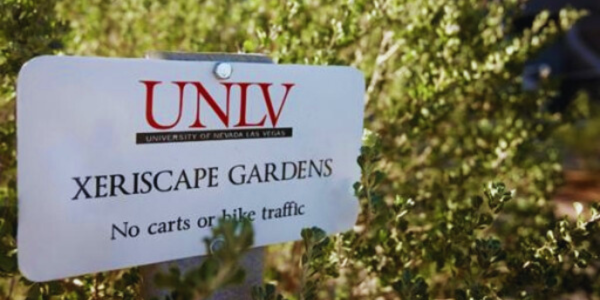
Walk Through a Living Laboratory of Water-Wise Desert Landscaping
The Donald H. Baepler Xeric Garden is a roughly two-acre demonstration garden outside the Marjorie Barrick Museum of Art at UNLV. Its winding paths lead through drought-tolerant trees, shrubs, succulents, groundcovers, grasses, and flowering plants adapted to desert and Mediterranean climates.
The garden shows how efficient irrigation and carefully selected plants can create a colorful, shaded landscape while using less water than a conventional lawn. Free outdoor access makes it an educational addition to the many free places to visit in Las Vegas.
Visitors can follow paved pathways, read plant-identification signs, rest beneath covered ramadas, look for birds, and explore the landscaping without purchasing a museum ticket or arranging a formal tour.
This is an outdoor university garden rather than a staffed botanical attraction. Plant conditions, water features, pathways, shade, construction access, and maintenance activity can vary throughout the year.
UNLV is replacing the roof above the adjacent Barrick Museum through September 30, 2026. Visitors may encounter fencing, equipment, workers, dust, noise, closed paths, or altered access near the building. Follow all posted signs and do not enter construction areas.
Last reviewed: July 20, 2026. Garden access, construction, pathways, parking rates, guided-tour availability, plant labels, water features, and museum hours can change.
Donald H. Baepler Xeric Garden Quick Facts
- Admission: Free to explore from legally accessible campus pathways.
- Reservations: Not required for an ordinary self-guided visit.
- Location: Outside the entrance to the Marjorie Barrick Museum of Art on the UNLV Maryland campus.
- Campus Address: 4505 S. Maryland Parkway, Las Vegas, NV 89154
- Garden Size: UNLV currently describes the Xeric Garden as approximately two acres.
- Pathways: The original garden design included more than 9,000 square feet of paved paths.
- Established: Completed in 1988.
- Designer: Jack Zunino & Associates.
- Main Features: Drought-tolerant plants, informative signs, benches, covered ramadas, wooden bridges, sandstone boulders, and bird habitat.
- Time Needed: Approximately 30 to 60 minutes for a casual walk and self-guided exploration.
- Best Season: Spring generally provides the broadest range of color and blooms.
- Best Time of Day: Morning or late afternoon during warm weather.
- Best For: Gardeners, birdwatchers, students, photographers, families, landscape-design enthusiasts, and visitors interested in water conservation.
- Grounds Contact: (702) 895-3392 or fmgrounds@unlv.edu
- Parking: Nearby visitor/pay spaces currently cost $2 per hour. Parking rules and rates can change.
- What May Cost Extra: Campus parking, transportation, organized programs, special events, and other UNLV activities.
What to Expect in the Xeric Garden
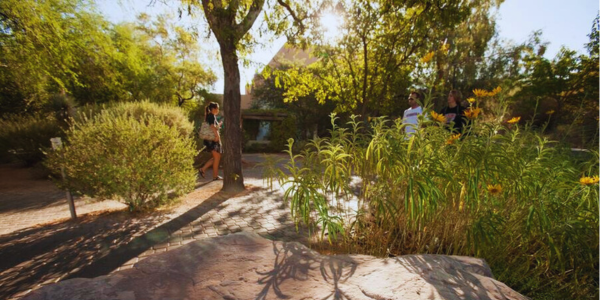
The garden surrounds the approach to the Barrick Museum and extends through a series of landscaped outdoor spaces. Paved paths curve around dense plantings, mature trees, flowering shrubs, desert-adapted groundcovers, agaves, grasses, rocks, benches, bridges, and shaded structures.
The layout demonstrates that water-wise landscaping does not have to consist only of gravel and cactus. Visitors can see how plants with different heights, forms, textures, flowering cycles, and shade patterns can be combined to create a visually varied desert garden.
Features may include:
- Plant-identification and educational signs
- Paved walking paths
- Covered ramadas
- Benches and resting areas
- Wooden footbridges
- Sandstone boulders
- Seasonal flowers
- Mature shade trees
- Bird habitat
- Water-conserving irrigation systems
The garden is part of an active university campus. Students, employees, museum visitors, maintenance crews, classes, events, photographers, and construction workers may use the same pathways.
No admission desk or garden attendant is normally stationed at the entrance. Visitors should explore independently, follow campus rules, and remain outside areas closed for maintenance, research, construction, or private events.
Plants From Desert and Mediterranean Regions
The garden includes plants from arid and seasonally dry regions around the world, including:
- Australia
- South America
- Mexico
- The Mediterranean region
- The Mojave Desert
- The Sonoran Desert
- The Chihuahuan Desert
- The Great Basin Desert
Plant examples historically documented at the garden include:
- Agave
- Blue yucca
- Creosote bush
- Jojoba
- Eucalyptus
- Desert-adapted shrubs
- Ornamental grasses
- Flowering perennials
- Succulents and other low-water plants
The exact collection changes as plants mature, decline, are replaced, or are affected by heat, freezes, pests, irrigation work, and university landscaping projects.
Informative signs throughout the garden may identify individual plants and explain where they originate. Some older signs may be weathered, missing, or associated with plants that have changed since the label was installed.
Klinkhammer Bird Viewing Ramada
The Klinkhammer Bird Viewing Ramada is at the northern end of the historic garden layout. It was designed as a shaded place where visitors could pause and look for local and migratory birds attracted to the garden’s trees, shrubs, shelter, food sources, and water.
The original design included a pool and wall intended to provide a water source for birds. Water levels and feature operation should not be assumed, since maintenance, drought measures, repairs, wildlife management, and seasonal conditions may affect the area.
Birds that may use desert campus landscapes include sparrows, finches, doves, hummingbirds, mockingbirds, grackles, verdins, and other Southern Nevada species. No particular species or sighting is guaranteed.
When watching birds:
- Remain on established paths and viewing areas.
- Keep voices and phone audio low.
- Do not chase, touch, trap, or disturb wildlife.
- Do not approach nests or fledglings.
- Do not feed birds unless UNLV specifically authorizes it.
- Keep photography equipment out of walkways and planted areas.
How the Baepler Xeric Garden Began
The garden was completed in February 1988 as one of the Las Vegas Valley’s first large-scale demonstrations of drought-tolerant landscaping.
Former UNLV grounds manager Dennis Swartzell proposed the project as an expansion of the campus arboretum. Local landscape architect Jack Zunino designed the garden, and community businesses contributed materials and labor.
The project was developed to demonstrate how plants suited to arid climates could be combined with efficient irrigation to conserve water while creating an attractive landscape.
Its original purposes included:
- Testing the suitability of drought-tolerant plants in Las Vegas
- Demonstrating water-efficient landscape design
- Expanding the educational value of the UNLV Arboretum
- Supporting environmental study
- Creating habitat for local and migratory birds
- Providing an outdoor learning and relaxation area
The garden was later named for Donald H. Baepler, a former UNLV president and Nevada higher-education chancellor who also directed the university’s former natural-history museum.
UNLV’s current arboretum program encompasses the entire 335-acre campus, including thousands of trees and multiple specialized garden areas.
Free Requested Guided Grounds Tour
UNLV’s Landscape, Grounds, and Arboretum Department accepts requests for guided campus-landscape tours.
Phone: (702) 895-3392
Email: fmgrounds@unlv.edu
Important: Contact the department in advance. A request does not guarantee availability, a particular date, or a private tour.
Schools, garden clubs, landscape professionals, environmental groups, and organized classes should coordinate ahead rather than arriving with a large group without notice.
How to Find the Baepler Xeric Garden
The garden is outside the Marjorie Barrick Museum of Art near the center-west side of the UNLV Maryland campus.
All buildings on the main campus use the shared address:
4505 S. Maryland Parkway
Las Vegas, NV 89154
Because the campus address covers many buildings and outdoor spaces, entering only the street address into a navigation app may not lead directly to the garden.
Map Location: Open the Donald H. Baepler Xeric Garden area in Google Maps.
From Harmon Avenue
Approach the west side of campus from University Center Drive and travel east on Harmon Avenue toward the university interior. The Barrick Museum and garden are near the point where the campus roadway reaches the museum area.
From Maryland Parkway
Visitors entering from the main Maryland Parkway side of campus should allow additional walking time. Follow current campus signs toward the Marjorie Barrick Museum of Art or use the official UNLV campus map.
Do not drive onto pedestrian malls, service paths, landscaping, restricted university roads, or construction areas while looking for the garden.
Visitor Parking Near the Garden
UNLV visitors must use spaces designated for visitor/pay parking or display an appropriate permit during enforced hours.
Current visitor/pay parking costs $2 per hour and is handled through the PayByPhone system. Metered or visitor spaces may be available:
- In the parking area outside the Barrick Museum entrance
- Along East Harmon Avenue
- Behind the Lied Library
- In the Cottage Grove Avenue Parking Garage
- In other marked visitor/pay areas around campus
UNLV’s Barrick Museum visitor information currently states that metered and eligible staff or student parking becomes free after 7:00 p.m. on weekdays, after 1:00 p.m. on Fridays, and throughout Saturday and Sunday. Confirm all signs and current enforcement rules before leaving a vehicle.
Do not park in faculty, staff, student, accessible, reserved, service, loading, construction, or permit-only spaces unless the posted rules clearly authorize your vehicle.
Review the current UNLV visitor-parking information before driving to campus.
Visitors using public transportation can review the Las Vegas public transportation guide. Rideshare users should confirm a legal campus drop-off point and consult the Las Vegas Ride Share Guide.
Best Time to Visit the Xeric Garden
Spring
UNLV identifies spring as the best overall season because many plants show flowers, fresh growth, or seasonal color at the same time.
Summer
Summer demonstrates how desert-adapted plants tolerate heat, but daytime temperatures can be dangerous. Visit early in the morning, carry water, use sun protection, and limit time on exposed pavement.
Fall
Cooling temperatures make walking more comfortable. Some plants may produce fall flowers, seeds, fruit, or changing foliage.
Winter
The garden remains educational during winter, although some plants may be dormant, damaged by freezes, pruned, or less colorful.
Morning
Morning usually provides cooler temperatures, more active birds, softer light, and fewer campus visitors.
Late Afternoon
Late-day light can emphasize plant textures and sandstone colors, but verify parking enforcement and allow enough daylight to navigate the pathways.
Tips Before Visiting
- Check construction notices: The adjacent Barrick Museum roof project may affect paths and access through September 30, 2026.
- Use the official map: The shared campus address does not identify the garden’s precise location.
- Download the self-guided brochure: It provides more context than walking through without a map.
- Visit in spring: This generally offers the broadest combination of flowers and color.
- Go early during warm months: Shade is available in places, but the garden remains an outdoor desert environment.
- Bring drinking water: Do not rely on a fountain or vending machine being available inside the garden.
- Wear practical shoes: Paved paths may include slopes, uneven joints, debris, wet areas, or temporary construction changes.
- Stay on established paths: Do not step into planting beds, climb rocks, or create shortcuts through vegetation.
- Do not collect plants: Leave flowers, seeds, leaves, rocks, and other garden materials in place.
- Do not disturb wildlife: Observe birds, insects, reptiles, and other animals from a respectful distance.
- Keep pathways open: Benches, bridges, ramps, museum approaches, and construction routes must remain accessible.
- Use photography courteously: Avoid blocking paths with tripods, reflectors, lighting stands, models, or large equipment.
- Ask about organized photography: Commercial shoots, portrait sessions, classes, and large productions may require university approval.
- Confirm parking: Pay only through approved UNLV systems and follow the signs attached to the individual space.
- Combine it with the museum carefully: The Barrick Museum is temporarily closed during its 2026 roof project. Check its current status before planning an indoor visit.
Donald H. Baepler Xeric Garden FAQ
Q: Is the Baepler Xeric Garden free?
A: Yes. No garden admission ticket is required for an ordinary self-guided visit from legally accessible campus pathways. Parking and organized activities may cost extra.
Q: What is a xeric garden?
A: A xeric garden uses drought-tolerant plants and efficient irrigation to create an attractive landscape with reduced water demand.
Q: Where is the garden located?
A: It is outside the entrance to the Marjorie Barrick Museum of Art on UNLV’s Maryland campus.
Q: What is the correct address?
A: UNLV’s main campus uses 4505 S. Maryland Parkway, Las Vegas, NV 89154. Use the garden or Barrick Museum map pin for more precise navigation.
Q: How large is the garden?
A: UNLV’s current arboretum page describes it as approximately two acres. Historical project information described the original site as 1.5 acres.
Q: Does the garden cover only 9,000 square feet?
A: No. The more-than-9,000-square-foot figure refers to the original paved pathways rather than the total garden area.
Q: When can visitors explore the garden?
A: UNLV states that the campus landscape may be toured at a leisurely pace at any time or day of the week. Construction, maintenance, events, weather, or safety restrictions may temporarily limit access.
Q: Are guided tours available?
A: Guided campus-landscape tours may be requested through UNLV’s Landscape, Grounds, and Arboretum Department. Advance contact is required, and availability is not guaranteed.
Q: Is there a self-guided tour?
A: Yes. UNLV provides a free downloadable Xeric Garden and Arboretum brochure with a map and information about different garden areas.
Q: What plants can visitors see?
A: The collection includes drought-tolerant plants associated with Australia, South America, Mexico, the Mediterranean, and four North American desert regions. The exact collection changes over time.
Q: What is the Klinkhammer Bird Viewing Ramada?
A: It is a shaded viewing area at the northern end of the historic garden design, created to help visitors observe local and migratory birds.
Q: Is the Barrick Museum currently open?
A: The museum is temporarily closed during its 2026 roof-renovation project. Check the official museum website for the latest reopening and exhibition information.
Q: Is parking free?
A: Nearby visitor/pay spaces currently cost $2 per hour during enforced periods. UNLV also publishes certain evening and weekend periods when eligible spaces are free. Always follow the signs for the individual space.
Q: Is the garden accessible to wheelchair users?
A: Much of the garden uses paved pathways, but grades, surface conditions, construction fencing, maintenance, and route closures can affect access. Contact UNLV before visiting with a specific mobility question.
Q: Is the garden appropriate for children?
A: Families can visit, but adults should supervise children around plants, bridges, water features, birds, insects, campus roads, construction zones, and university buildings.
Q: Is the garden worth a special trip?
A: It may be worthwhile for gardeners, birdwatchers, photographers, and water-conservation enthusiasts. Casual visitors may prefer to combine it with another UNLV destination or nearby museum after confirming current access.