See a Working Renewable-Energy Research Site Along Flamingo Road
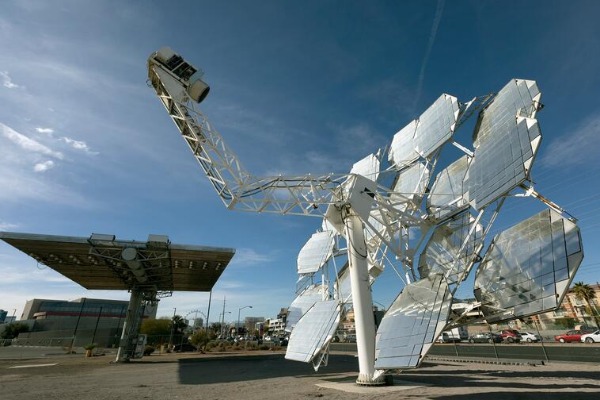
The UNLV Solar Site is an outdoor research installation operated by the university’s Center for Energy Research. Its oversized solar dishes and photovoltaic structures are visible near the northwest corner of the UNLV campus, where Flamingo Road meets University Center Drive.
The unusual equipment provides a quick educational stop among the more unconventional free things to see in Las Vegas. Visitors can observe the structures from legal public road, sidewalk, and campus areas without purchasing an attraction ticket.
This is not a conventional museum, visitor center, or walk-through exhibit. UNLV does not currently publish regular public-tour hours for the Solar Site, and visitors should not enter fenced research areas, equipment compounds, laboratories, or restricted work zones without advance authorization.
The site is most worthwhile for renewable-energy students, engineers, solar-power enthusiasts, and people curious about the large mechanical structures they have noticed while driving along Flamingo Road.
Last reviewed: July 20, 2026. Research equipment, campus access, parking rates, construction, public pathways, contact information, and educational-visit procedures can change.
UNLV Solar Site Quick Facts
- Cost: Free to view from legally accessible public road, sidewalk, and campus areas.
- Experience Type: Outdoor roadside and campus-viewing stop beside an active research facility.
- Public Tours: UNLV does not currently publish regular walk-in tour hours for the Solar Site.
- Location: Northwest corner of the UNLV Maryland campus near Flamingo Road and University Center Drive.
- Former Street Name: University Center Drive was previously named Swenson Street and may still appear under the older name in some directions.
- Nearby Building: William D. Taylor Hall, identified on UNLV maps as TAY.
- Main Features: Concentrating photovoltaic equipment, a large solar-dish system, and a façade-testing facility.
- Operator: UNLV Center for Energy Research in the Howard R. Hughes College of Engineering.
- Center Phone: (702) 895-1125
- Time Needed: Approximately 10 to 25 minutes for an exterior look and photographs.
- Best For: Solar-energy enthusiasts, engineering students, educators, technology fans, and curious passersby.
- Best Time: Daylight, when the equipment and structural details are easiest to see.
- Parking: Visitor/pay spaces are available in nearby Lot T. Current short-term visitor parking is $2 per hour.
- Free Parking Alternative: UNLV lists Lot S as a free campus lot, but it is farther from the Solar Site.
- What May Cost Extra: Campus parking, transportation, organized programs, and other UNLV activities.
What to Expect at the UNLV Solar Site
The Solar Site occupies an outdoor research area along the northern edge of the university campus. Large steel frameworks, photovoltaic panels, tracking equipment, experimental components, and mechanical systems make it easy to recognize from Flamingo Road.
The installation may look like an outdoor science museum from a distance, but it functions as a university engineering and testing site. Researchers may modify, maintain, operate, deactivate, or replace equipment as projects change.
Visitors should not expect:
- A staffed admission desk
- Regular attraction hours
- A public observation deck
- A guaranteed equipment demonstration
- Unrestricted entry into the research compound
- A guide stationed onsite
- Every solar system to be operating or moving
The safest ordinary experience is to observe the equipment from established public areas outside gates, fences, vehicle lanes, and active work zones.
What Equipment Is at the Solar Site?
Concentrating Photovoltaic Systems
Concentrating photovoltaic systems use mirrors or optical components to focus sunlight onto smaller, high-efficiency photovoltaic cells. Tracking mechanisms position the equipment toward the sun as its angle changes throughout the day.
UNLV currently identifies Amonix concentrating photovoltaic systems among the equipment housed at the Flamingo Road site.
Large Solar-Dish System
The site’s most visually distinctive structure is its large solar-dish equipment. Reflective panels concentrate sunlight toward a focal area where experimental power-generation or measurement components can be tested.
The dish may not rotate or operate continuously. Maintenance, weather, project status, equipment age, safety procedures, and research needs can affect its position and operation.
Façade Evaluation Facility
The Solar Site also includes a facility for testing exterior building components. Researchers can study the thermal and optical performance of windows, building-integrated photovoltaic systems, and other façade materials under Southern Nevada’s intense sunlight and desert temperatures.
This equipment supports engineering research rather than functioning as an interactive visitor exhibit.
How the UNLV Solar Site Developed
UNLV installed its original solar-dish research systems along Flamingo Road in 2001. The project was supported by the United States Department of Energy and designed to help engineering students and researchers study solar-power technology.
The equipment allowed university teams to:
- Study the operation of large solar-tracking systems
- Test photovoltaic and concentrating-solar technologies
- Collect performance data in a hot desert climate
- Evaluate cooling methods and system efficiency
- Give students practical experience with renewable-energy equipment
- Work with government agencies and private technology companies
Historical UNLV information stated that systems at the site could produce up to 100 kilowatts when operating. That figure describes earlier configurations and should not be treated as a guarantee of current output.
The appearance, dimensions, components, and operating condition of the research systems have changed as technologies and university projects have evolved.
What Does the Center for Energy Research Study Today?
The Center for Energy Research conducts work across multiple laboratories and testing locations. Not every project is based at the Flamingo Road Solar Site.
Current center-wide projects listed by UNLV include:
- Testing photovoltaic and concentrating-photovoltaic systems
- Evaluating appliances using blends of natural gas and hydrogen
- Developing precision angle-measurement methods for improved heliostat performance
The center’s broader areas of interest include solar power, green buildings, hydrogen, fuel cells, advanced nuclear-energy concepts, energy storage, microgrids, electric-power quality, solar materials, and high-efficiency photovoltaic technology.
Several topics mentioned on older versions of this page are now listed by UNLV as completed projects, including:
- The earlier hydrogen filling station project
- An air-cooled condenser project for desert climates
- Design work for a thorium molten-salt small modular reactor
- Several Solar Decathlon and energy-efficient-home programs
These completed projects remain part of the center’s history, but visitors should not expect to find each one operating or displayed at the Flamingo Road site.
Review the Center for Energy Research’s current and completed projects.
Can the Public Enter or Tour the Solar Site?
UNLV does not currently publish regular public admission hours, a self-guided tour, or a weekly visitor schedule for the Solar Site.
Do not open gates, climb fences, enter equipment areas, approach electrical systems, touch controls, or walk into research and maintenance zones. University researchers and contractors may be working with moving equipment, concentrated sunlight, high temperatures, electricity, tools, and vehicles.
Schools, engineering groups, educators, and organizations interested in a possible educational visit should contact the Center for Energy Research before arriving. An inquiry does not guarantee that a tour, demonstration, or group visit will be available.
Phone: (702) 895-1125
Official Website: UNLV Center for Energy Research
Note: Contact the center in advance when requesting information about educational access, research partnerships, or organized visits.
How to Find the UNLV Solar Site
The Solar Site is on the northwest edge of UNLV’s Maryland campus, near the intersection of Flamingo Road and University Center Drive.
University Center Drive was known as Swenson Street before its 2019 name change. Older articles, maps, videos, and directions may therefore refer to the site as being at Flamingo and Swenson.
William D. Taylor Hall is beside the solar equipment and is identified as building TAY on the current UNLV campus map.
Map Location: Open the UNLV Solar Site area in Google Maps.
Do not stop on Flamingo Road, block the campus access road, enter a service driveway, or park beside research equipment to take photographs.
Visitor Parking Near the Solar Site
Lot T Visitor/Pay Spaces
Lot T is near Taylor Hall and can be accessed from the Flamingo campus access road. It contains a mixture of student, faculty, accessible, motorcycle, and visitor/pay spaces.
Visitors must park only in spaces specifically marked for visitor or paid use and complete payment before leaving the vehicle. UNLV currently lists short-term visitor parking at $2 per hour.
Free Lot S
UNLV currently identifies Lot S, near Harmon Avenue and University Center Drive, as a free parking lot that does not require a permit. It is considerably farther from the Solar Site and requires a longer outdoor walk.
Parking rules, enforcement hours, rates, space designations, construction closures, and event restrictions can change. Review the current UNLV visitor-parking information before driving to campus.
Visitors using public transportation can review the Las Vegas public transportation guide. Rideshare users should confirm a safe campus drop-off point and consult the Las Vegas Ride Share Guide.
Tips Before Viewing the Solar Site
- Visit during daylight: The equipment is easier to identify and photograph when the structures are fully illuminated.
- Treat it as a research facility: This is not an interactive museum or unsupervised playground.
- Remain outside restricted areas: Do not pass through gates, fences, barriers, laboratories, or marked work zones.
- Do not touch equipment: Solar, electrical, mechanical, and tracking systems can present serious hazards.
- Do not stare at concentrated sunlight: Reflected light from solar equipment can be extremely bright and potentially harmful.
- Use legal parking: Visitor/pay spaces require payment, and most other campus spaces require an appropriate permit.
- Do not stop along Flamingo Road: Use a legal parking space or designated drop-off area.
- Expect changing equipment: Research structures may be moved, modified, inactive, covered, or removed as projects evolve.
- Keep photography simple: Casual exterior photographs are more practical than tripods, lights, drones, or professional equipment.
- Ask before organized filming: Commercial photography, news production, educational filming, and group projects may require university approval.
- Bring water in warm weather: The surrounding campus edge has limited shade and can become extremely hot.
- Contact UNLV for a group visit: Do not bring a class or organized group expecting access without advance coordination.
Learn More About the UNLV Solar Site
This video provides a closer look at the solar research equipment. The systems, research projects, surrounding buildings, street names, and public access may have changed since it was recorded.
UNLV Solar Site FAQ
Q: Is the UNLV Solar Site free to see?
A: Yes. The large outdoor equipment can be viewed from legally accessible road, sidewalk, and campus areas without purchasing an attraction ticket. Campus parking may cost extra.
Q: Is the Solar Site a public museum?
A: No. It is an active university research facility rather than a conventional museum, visitor center, or walk-through attraction.
Q: Can visitors enter the fenced research area?
A: Not without authorization. Remain outside gates, fences, laboratories, equipment compounds, and restricted work areas.
Q: Are free public tours available?
A: UNLV does not currently publish regular walk-in tour hours for the Solar Site. Contact the Center for Energy Research in advance with an educational or group-visit inquiry.
Q: Where is the Solar Site?
A: It is near Flamingo Road and University Center Drive at the northwest corner of UNLV’s Maryland campus, beside William D. Taylor Hall.
Q: Is University Center Drive the same as Swenson Street?
A: Yes. The street was renamed University Center Drive in 2019, so older information may still use the Swenson Street name.
Q: Does the site still produce enough electricity for 20 homes?
A: The comparison came from historical information about earlier equipment producing up to 100 kilowatts. UNLV does not currently guarantee that output from the present configuration.
Q: Is the hydrogen filling station still operating?
A: UNLV lists its earlier hydrogen filling station among completed projects from 2004 through 2010 rather than as a current public Solar Site feature.
Q: Is the thorium reactor project located here?
A: No public reactor attraction operates at the Solar Site. UNLV lists the small modular thorium molten-salt reactor design among completed research projects.
Q: Can visitors see the solar dishes move?
A: Movement is not guaranteed. Equipment operation depends on the project, weather, maintenance, safety procedures, and current research needs.
Q: Where can visitors park?
A: Nearby Lot T includes visitor/pay spaces. UNLV also lists free parking in Lot S, which is farther from the Solar Site.
Q: Is the Solar Site suitable for children?
A: Families can view the exterior equipment from safe public areas, but adults must keep children away from roads, parking lots, fences, gates, electrical equipment, and restricted research areas.
Q: Is the UNLV Solar Site worth a special trip?
A: It may be worthwhile for renewable-energy, engineering, and technology enthusiasts. Most casual visitors should treat it as a brief stop while already near UNLV rather than a major stand-alone attraction.