Las Vegas Rescue Mission
Emergency Shelter, Daily Meals, Recovery Services, and Community Support in Las Vegas
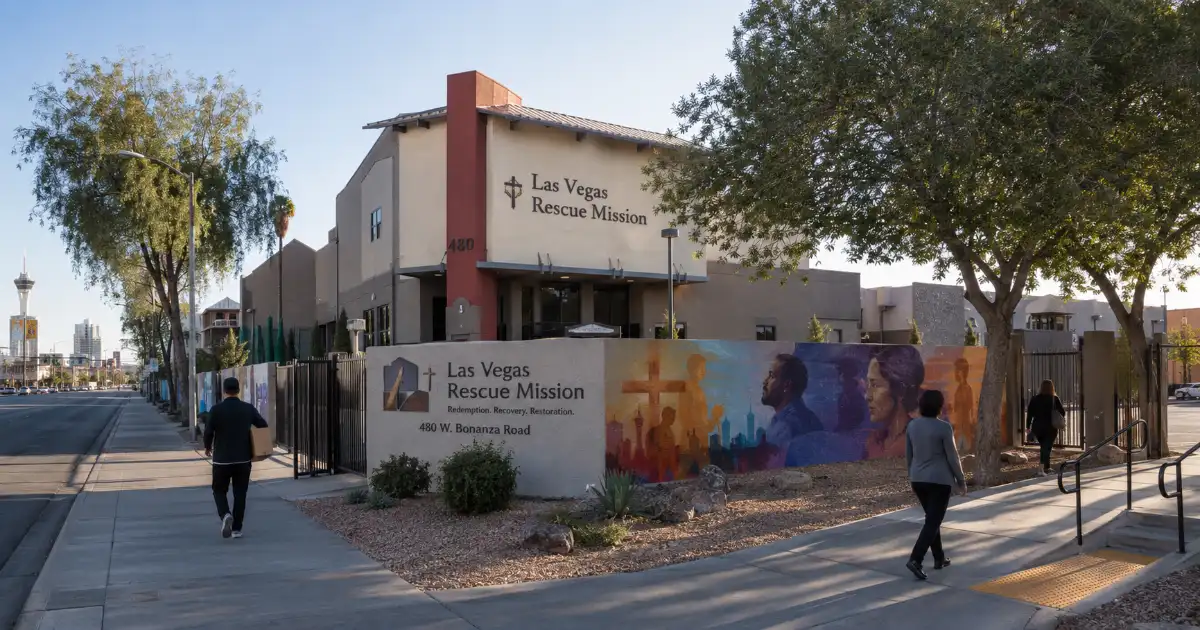
Las Vegas Rescue Mission is a private, faith-based nonprofit at 480 W. Bonanza Road. Its downtown campus provides emergency shelter, a public evening meal, basic-needs support, residential addiction recovery, case management, volunteer opportunities, donation collection, and a public thrift store.
The mission serves men, women, children, and families through several separate programs. Each service uses its own schedule, entrance, eligibility rules, check-in process, and capacity limits.
The campus is not an unrestricted public facility. Shelter dormitories, treatment areas, offices, kitchens, storage spaces, residential areas, and operational buildings may be limited to approved guests, employees, volunteers, donors, patients, or invited visitors.
Last reviewed: July 26, 2026. Meal service, shelter intake, recovery-program availability, donation rules, volunteer shifts, thrift-store hours, campus access, and operating procedures can change. Confirm current information before visiting.
Quick Facts | Services | Community Meal | Emergency Shelter | Recovery Program | Basic Needs | Donations | Volunteering | Thrift Store | Faith-Based Mission | Campus Access | Parking | Transportation | Accessibility | Visitor Tips | FAQ
Quick Facts
Official Name:
Las Vegas Rescue Mission
Address:
480 W. Bonanza Road, Las Vegas, NV 89106
Main Phone:
(702) 382-1766
Organization Type:
Private, nonprofit, Christian and faith-based human-services organization
Venue Type:
Emergency shelter, public-meal location, recovery-program facility, donation center, volunteer destination, thrift store, and nonprofit administrative campus
Public Community Meal:
Daily from 5:00 p.m. to 6:00 p.m. under the current schedule
Current Meal Entrance:
Guests line up at the west gate.
Current Shelter Intake:
Daily at 3:00 p.m. and again at 6:00 p.m. after the community meal
Shelter Availability:
First come, first served and dependent on available space, eligibility, screening, and current operating rules
Administrative Office Hours:
Monday through Friday from 8:30 a.m. to 5:00 p.m.
Donation Drop-Off:
Available under current in-kind donation procedures. Confirm the accepted items and correct entrance before arriving.
Volunteering:
Advance registration and required waivers apply to scheduled volunteer shifts.
Thrift Store:
Open to the public under a separate schedule that may change seasonally.
Important:
A meal visit, shelter request, donation drop-off, volunteer shift, recovery inquiry, or thrift-store visit applies only to that service and does not provide access to other campus areas.
Services at Las Vegas Rescue Mission
Las Vegas Rescue Mission assists people experiencing homelessness, hunger, substance-use disorders, housing instability, and other immediate needs.
Its principal services include emergency shelter, meals, clothing and hygiene support, case management, residential recovery, employment preparation, family support, volunteer service, donation collection, and thrift-store operations.
The availability of one service does not guarantee eligibility for another. Shelter, recovery, extended stay, basic needs, and special programs use separate assessments and capacity limits.
People seeking immediate help should confirm the current procedure before traveling whenever they have access to a telephone.
Daily Community Meal and Basic Needs
The mission currently serves a free community dinner every day from 5:00 p.m. to 6:00 p.m. The meal is open to the public, and guests are directed to line up at the west gate.
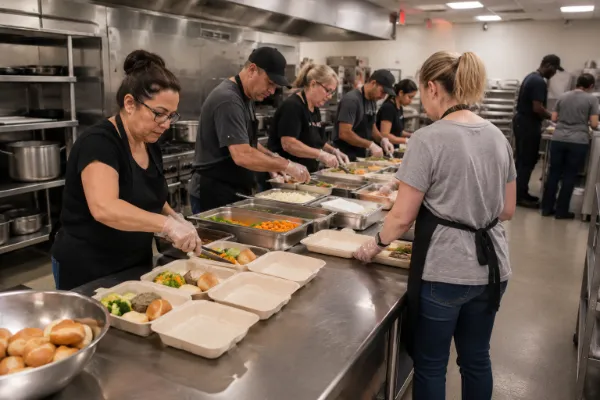
Meal access does not guarantee shelter, recovery-program admission, transportation, clothing, or entry into other campus buildings.
Guests should follow the current line, gate, security, personal-property, and dining instructions supplied by mission staff.
Meal times, entry routes, holiday procedures, weather accommodations, and dining arrangements can change.
Large groups should not arrive to distribute food, clothing, cash, religious materials, or other items directly to meal guests without advance approval from the mission.
Shelter of Hope and Emergency Intake
The Shelter of Hope provides emergency accommodation and basic support to eligible individuals and families experiencing homelessness.
The mission currently accepts single men, single women, single fathers, single mothers, children, and intact family groups when appropriate space is available.
Current intake is held daily at 3:00 p.m. and again at 6:00 p.m. after the community meal. Intake is first come, first served.
An arrival at intake time does not guarantee a bed. Admission depends on available capacity, screening, current eligibility requirements, safety procedures, and compliance with shelter rules.
The current published emergency-stay period is up to 14 nights for single adults and up to 30 days for guests with children. Individual circumstances and program placement may affect the actual stay.
Guests and their belongings are subject to screening. The mission currently conducts background checks, uses breath testing before entry, and restricts admission for people listed on a sex-offender registry.
Medications, belongings, identification, children’s items, mobility devices, and other personal property may follow special storage or safety procedures.
Anyone facing an immediate medical, psychiatric, domestic-violence, trafficking, or safety emergency should use the appropriate emergency or crisis service rather than assume that ordinary shelter intake can address every situation.
Lighthouse Recovery Program
Lighthouse Recovery is a Christian-based residential drug-and-alcohol treatment program for adult men and women.
The current program is structured as a six-month residential commitment that combines clinical care, case management, peer support, structured living, work therapy, life-skills development, relapse prevention, and spiritual support.
Recovery-program access is separate from emergency-shelter intake. Prospective participants must complete the mission’s current inquiry, screening, eligibility, sobriety, and admission procedures.
A person should not arrive expecting immediate residential placement without first confirming intake availability.
Program schedules, bed availability, costs or contributions, personal-property rules, electronics policies, medications, outside employment, visitation, and discharge procedures may change.
The program’s Christian and residential structure should be reviewed carefully before enrollment.
Hygiene Items, Clothing, and Case Support
The mission may provide eligible guests with hygiene kits, clothing, and other basic-needs assistance according to available supplies and current procedures.
Hygiene kits are currently available upon request and may include feminine-care products. Adult diapers may also be available.
Supply availability changes according to donations, weather, demand, funding, and individual circumstances.
Do not assume that every item, clothing size, hygiene product, transportation service, identification service, or financial resource is immediately available.
Case-management and extended-stay services may help eligible participants pursue identification, employment, education, benefits, certifications, housing, and other stability goals.
In-Kind Donations and Donation Drop-Off
Las Vegas Rescue Mission accepts eligible in-kind donations for direct services, distribution, and thrift-store operations.
Accepted and urgently needed items change throughout the year. Donors should review the mission’s current list before loading or transporting goods.
The mission currently limits ordinary food donations to nonperishable products that can be used in its kitchen. Perishable or precooked food requires approved transportation, temperature control, and supporting food-safety documentation.
Do not donate expired, damaged, recalled, opened, unsafe, heavily soiled, or prohibited items.
Donation drop-off is separate from shelter intake, meal access, the thrift-store entrance, and volunteer check-in. Follow current signs and staff directions.
Home pickup may be requested for eligible items, but availability is not guaranteed.
Ask the mission directly about receipts, valuation, large items, furniture, vehicles, food donations, estate donations, and business collections.
Volunteer Opportunities
The mission schedules volunteers for community dinner service, thrift-store and warehouse work, donation support, and other approved assignments.
Individuals and groups should register through the current volunteer system and complete the required waivers before arriving.
Volunteer assignments may use age requirements, dress standards, closed-toe shoes, food-safety procedures, identification, orientation, supervision, and arrival deadlines.
A person should not enter shelter, residential, treatment, kitchen, warehouse, or administrative areas without an assigned shift and staff authorization.
Ordinary volunteer shifts do not count automatically toward court-ordered community service. Court-ordered service uses a separate sign-up and check-in procedure.
Current volunteer openings, shift times, group capacity, and community-service schedules can change.
Las Vegas Rescue Mission Thrift Store
The mission operates a public thrift store that sells donated clothing, furniture, household goods, kitchenware, electronics, and other changing inventory.
Store proceeds support mission services, and some donated goods may be distributed directly to eligible people rather than offered for sale.
The thrift store uses a separate schedule that may change seasonally. Confirm current shopping hours before visiting.
Inventory, item condition, discounts, delivery, furniture availability, payment methods, exchange policies, and sales terms can change.
A thrift-store purchase does not provide access to shelter, treatment, residential, volunteer, kitchen, or administrative areas.
Faith-Based Mission and Religious Programming
Las Vegas Rescue Mission is a Christian organization whose stated mission includes offering hope through Jesus Christ.
Spiritual guidance, pastoral care, Bible study, chapel activities, and Christian principles may form part of residential or recovery programming.
People considering a long-term residential program should ask how religious activities relate to the program schedule and participation expectations.
The organization states that it provides services without unlawful discrimination and lists protected characteristics in its official service policy.
Campus Access, Security, and Privacy
The mission campus includes shelter, dining, recovery, administrative, donation, warehouse, chapel, thrift-store, and service areas.
Use the entrance specified for the selected service. The west gate used for the public meal may not be the correct entrance for shelter intake, donations, volunteering, offices, recovery inquiries, or thrift-store shopping.
Visitors may be asked to check in, state their purpose, present identification, follow screening requirements, receive a badge, or wait for an escort.
Do not enter dormitories, residential areas, treatment spaces, offices, kitchens, warehouses, or staff areas without authorization.
Do not photograph or record shelter guests, children, residents, recovery participants, staff records, intake activity, license plates, medications, or private conversations.
Media visits, organized tours, commercial filming, interviews, donation presentations, and group distributions require advance approval.
Parking, Loading, and Drop-Off
Parking and vehicle access depend on the visitor’s purpose, including meal service, shelter intake, volunteering, donations, thrift-store shopping, appointments, and deliveries.
Use posted signs and follow staff instructions. Do not assume that every gate, lot, curb, loading area, or space is open for public parking.
Parking may be limited during meal service, shelter intake, volunteer shifts, donation activity, holiday programs, and large community events.
Do not park in fire lanes, loading zones, staff spaces, gated service areas, accessible spaces without authorization, neighboring private lots, or railroad-related property.
Large donations, furniture, pallets, food deliveries, and commercial vehicles should be coordinated before arrival.
Passenger drop-off must not block gates, sidewalks, intake lines, loading areas, accessible routes, or emergency access.
Transit, Rideshare, Taxi, and Walking
RTC service operates in the downtown and Bonanza Road area. Routes, stops, fares, schedules, and overnight service can change.
Use the full organization name and 480 W. Bonanza Road when requesting a rideshare or taxi.
Confirm the correct gate or entrance before ending the ride. Different services may use different parts of the campus.
People attending shelter intake or the community meal should plan the return trip and consider weather conditions, mobility, personal belongings, and service ending times.
Pedestrians should use marked routes and avoid vehicle gates, loading areas, railroad property, and restricted campus entrances.
Accessibility and Individual Assistance
People who need a step-free route, accessible intake area, mobility accommodation, communication assistance, service-animal access, medication support, or another arrangement should contact the mission before arriving when possible.
Access can differ among the dining area, shelter facilities, thrift store, volunteer locations, offices, chapel, recovery residences, and donation areas.
Shelter capacity, dormitory configuration, family placement, mobility needs, medical conditions, and personal-care requirements may affect whether the mission can provide an appropriate placement.
The mission is not a hospital, emergency department, inpatient psychiatric facility, or skilled-nursing center.
Mobility devices, bags, carts, and personal belongings must not block gates, aisles, dormitory routes, dining areas, exits, or emergency access.
Tips Before You Visit
Confirm the correct service and entrance.
Meal access, shelter intake, donations, volunteering, recovery inquiries, and thrift-store shopping follow different procedures.
Do not assume that shelter is guaranteed.
Intake is first come, first served and depends on available capacity and screening.
Arrive at the current meal time.
The public dinner is presently served from 5:00 p.m. to 6:00 p.m., with guests directed to the west gate.
Check donation rules before loading a vehicle.
Accepted items, food-safety rules, urgent needs, and pickup availability can change.
Register before volunteering.
Volunteer shifts require scheduling and completed waivers.
Respect privacy.
Do not photograph, film, interview, or identify people receiving shelter, meals, treatment, or other services.
Find additional immediate-help options.
Review the Las Vegas homeless resources guide for shelters, food, showers, medical support, youth services, and other assistance.
Explore service opportunities.
The Las Vegas volunteering guide lists additional nonprofit organizations seeking community support.
Frequently Asked Questions
Q: Where is Las Vegas Rescue Mission?
A: The mission is at 480 W. Bonanza Road in downtown Las Vegas.
Q: Does the mission serve a free public meal?
A: Yes. The current community dinner is served daily from 5:00 p.m. to 6:00 p.m., with guests directed to line up at the west gate.
Q: When does emergency-shelter intake occur?
A: Current intake is held daily at 3:00 p.m. and again at 6:00 p.m. after the evening meal.
Q: Is an emergency-shelter bed guaranteed?
A: No. Shelter is first come, first served and depends on available capacity, eligibility, screening, and compliance with current rules.
Q: Does the mission serve families?
A: Yes. Its current shelter model includes single parents with children and intact family groups when appropriate space is available.
Q: Can people donate clothing, furniture, or food?
A: Yes, but accepted items and food-safety requirements change. Review the current donation list and drop-off instructions before arriving.
Q: Can individuals and groups volunteer?
A: Yes. Volunteers must register for an available shift and complete the required waivers. Court-ordered community service follows a different process.
Q: Is the thrift store open to the public?
A: Yes. The thrift store sells changing donated inventory under a separate schedule that should be confirmed before visiting.