Follow a Free Trail of Restored Neon Through Downtown Las Vegas
The Las Vegas Boulevard Scenic Byway Neon Signs Project preserves 15 signs from former casinos, motels, and local businesses as public art. The restored displays stand along the downtown section of Las Vegas Boulevard, creating a colorful route through several eras of roadside design.
The collection is a distinctive option for visitors exploring free things to do in Las Vegas. No ticket, reservation, or formal tour is required, but the signs are distributed along a busy urban roadway rather than contained inside one walkable museum campus.
Visitors can see the signs during the day, when their lettering, shapes, paint, and construction details are easier to examine. After dark, many illuminate in neon and incandescent bulbs, although individual signs may occasionally be dark because of maintenance or electrical problems.
Last reviewed: July 20, 2026. Sign lighting, pedestrian routes, road construction, landscaping, traffic patterns, and public access can change. Check current downtown conditions before planning a complete walking route.
Historic Neon Signs Quick Facts
- Cost: Free to view from public sidewalks and other legally accessible areas.
- Number of Historic Signs: 15 restored signs in the official Las Vegas Boulevard Scenic Byway collection.
- Location: Distributed along Las Vegas Boulevard in Downtown Las Vegas, from the Fremont Street area north toward The Neon Museum and Washington Avenue.
- Hours: There is no gated attraction or published opening schedule. Public viewing depends on current sidewalk, street, and construction access.
- Lighting: Many signs are designed to illuminate after dark, but a specific sign may be unlit because of maintenance or operating conditions.
- Time Needed: About 15 minutes for one or two nearby signs; allow considerably longer to explore the full corridor.
- Best For: Neon enthusiasts, photographers, design and architecture fans, Downtown visitors, and Las Vegas history enthusiasts.
- Experience Type: Self-guided outdoor public-art route.
- Weather: The route is exposed to desert sun, heat, wind, and seasonal cold, with limited shade along some sections.
- Safety Note: Many signs stand in center medians. View them from legal sidewalks and crossings rather than entering traffic lanes or landscaped medians.
- What Costs Extra: Parking, transportation, food, drinks, paid museum admission, guided tours, and other Downtown activities.
What to Expect Along the Neon Route
The Scenic Byway collection is not a single fenced attraction. The signs are installed at different points along Las Vegas Boulevard, often in landscaped center medians between active traffic lanes.
Some signs are close enough to combine during a short walk. Others are separated by several intersections, freeway infrastructure, construction zones, or less comfortable pedestrian stretches. Trying to visit all 15 on foot requires advance planning, comfortable shoes, and suitable weather.
The collection includes tall casino signage, animated roadside symbols, motel marquees, arrows, lettering, and imagery that once attracted drivers to businesses across the Las Vegas Valley. Several signs retain recognizable mid-century colors and shapes even when viewed during daylight.
The installations are owned by the City of Las Vegas, The Neon Museum, and YESCO Custom Electric Signs. YESCO restored the eight signs added in 2023 as part of the Las Vegas Boulevard Improvement Project.
Map of the 15 Historic Neon Signs
The map below shows the order and approximate locations of the 15 official signs. Use it as an orientation guide rather than a turn-by-turn pedestrian route, since roadwork, crossings, sidewalks, and traffic access may change.
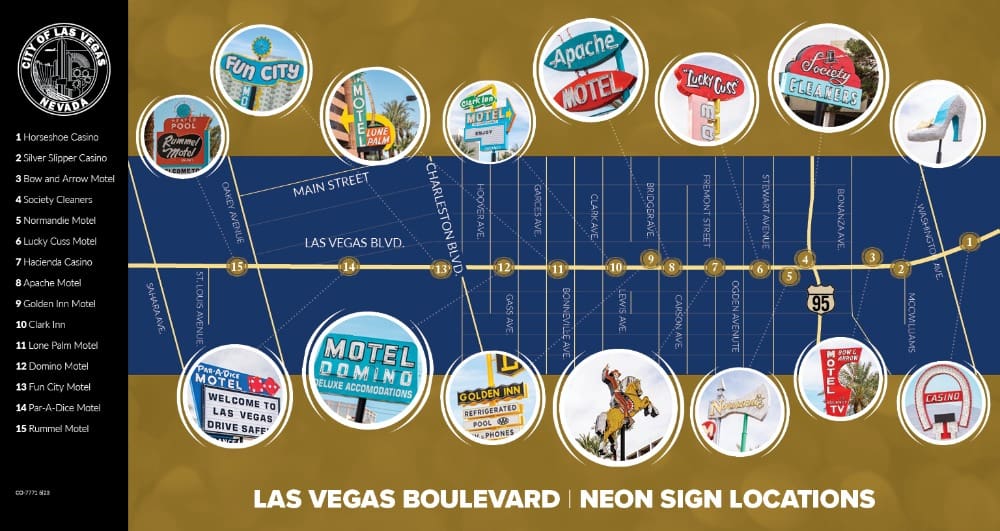
Before setting out, review the City of Las Vegas historic neon-sign map and project information.
The 15 Las Vegas Boulevard Neon Signs
1. Binion’s Horseshoe
The large horseshoe-shaped casino sign stands just north of Washington Avenue near the northern end of the route. It recalls Binion’s Horseshoe, the Downtown casino opened by Benny Binion in 1951 and associated with the early World Series of Poker.
2. Silver Slipper
The rotating-slipper design once advertised the Silver Slipper casino. The restored sign is displayed near The Neon Museum around McWilliams Avenue.
3. Bow & Arrow Motel
This roadside motel sign features a bold arrow piercing a circular target. It stands south of McWilliams Avenue and is commonly attributed to Betty Willis, designer of the Welcome to Fabulous Las Vegas sign, although the attribution is not fully documented.
4. Society Cleaners
The Society Cleaners sign uses a red top hat and cane to represent a longtime Fremont Street dry-cleaning business operated by Wayne and Braunda Gamette. It is positioned south of the U.S. 95 and Interstate 515 crossing.
5. Normandie Motel
The Normandie sign uses a distinctive angular shape and restrained mid-century lettering. It stands north of Stewart Avenue and is among the signs connected to designer Betty Willis.
6. Lucky Cuss Motel
This playful motel sign uses a Western-themed name and red lettering. It is displayed south of Stewart Avenue.
7. Hacienda Horse and Rider
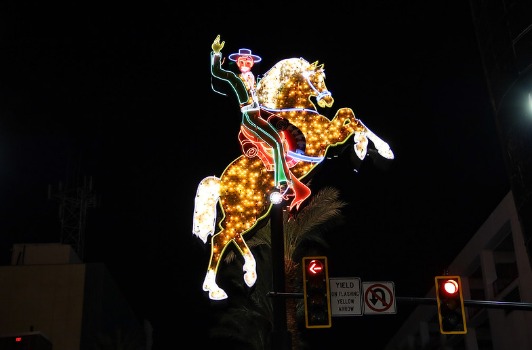
The Horse and Rider depicts a waving cowboy mounted on a rearing palomino. Originally created for the Hacienda Hotel and Casino, it became the first sign restored by The Neon Museum in 1996 and now stands near Las Vegas Boulevard and Fremont Street.
8. Apache Motel
The Apache Motel sign is installed north of Bridger Avenue. Its name reflects a period when roadside businesses frequently borrowed Indigenous names and imagery without considering cultural context.
9. Golden Inn Motel
The colorful Golden Inn sign stands south of Bridger Avenue. Its rounded shapes, arrow, and pool and telephone references reflect late-1950s motel advertising.
10. Clark Inn Motel
The Clark Inn sign is positioned north of Clark Avenue. The former East Fremont motel was operated by the Clark family and was known for rounded architectural features and a large family garden.
11. Lone Palm Motel
The Lone Palm sign stands north of Garces Avenue. The motel once operated near Tropicana Avenue and Las Vegas Boulevard, where New York-New York now stands.
12. Domino Motel
The Domino Motel sign is located north of Hoover Avenue. Its direct lettering and simple arrow reflect the efficient roadside advertising used by many small Downtown motels.
13. Fun City Motel
This bright and playful sign stands just south of Charleston Boulevard. The property began under earlier motel names before becoming the pink-and-white Fun City Motel during the 1980s.
14. Par-A-Dice Motel
The Par-A-Dice sign uses a gambling-themed pun and a traditional roadside marquee. It is installed just north of Oakey Boulevard.
15. Rummel Motel
The Rummel Motel sign stands south of Oakey Boulevard near the southern end of the historic-sign collection. Its circular red and white design represents a motel that operated for decades before suffering major fire damage.
Read more about the individual signs through The Neon Museum’s official Scenic Byway Project guide.
How the Las Vegas Signs Project Developed
The Neon Museum began restoring retired Las Vegas signs for public display before it opened its permanent museum campus. The Hacienda Horse and Rider became the first restored installation in 1996.
The Silver Slipper, Bow & Arrow Motel, and Binion’s Horseshoe signs were added near the future Neon Museum campus in 2009. Society Cleaners, Normandie Motel, and Lucky Cuss followed during later phases of the project.
Las Vegas Boulevard between Sahara Avenue and Washington Avenue received federal recognition as an urban scenic byway in 2009. The designation helped reinforce the corridor’s architectural, cultural, and roadside-significance value.
In 2023, the City of Las Vegas completed another major expansion by installing eight restored motel signs:
- Apache Motel
- Clark Inn Motel
- Domino Motel
- Fun City Motel
- Golden Inn Motel
- Lone Palm Motel
- Par-A-Dice Motel
- Rummel Motel
The eight additions joined the seven previously installed signs, creating the current 15-sign collection. The broader streetscape also includes modern gateway arches and showgirl signage, but those newer installations are not part of the official list of 15 restored historic signs.
How to Explore the Signs Safely
The easiest way to begin is to select one part of the corridor rather than attempting all 15 signs during a single walk.
Fremont Street Area
The Hacienda Horse and Rider near Fremont Street is the most convenient individual sign for visitors already exploring the Fremont Street Experience and Downtown casinos.
Neon Museum Area
The Binion’s Horseshoe, Silver Slipper, and Bow & Arrow signs can be paired with a visit to The Neon Museum. Museum admission is separate and costs extra.
Central Scenic Byway
The Society Cleaners, Normandie, Lucky Cuss, Apache, Golden Inn, Clark Inn, Lone Palm, and Domino signs are distributed through the central Downtown corridor. Pedestrian comfort varies by block.
Charleston and Oakey Area
Fun City, Par-A-Dice, and Rummel are located farther south around Charleston and Oakey boulevards. These signs may be easier to include as part of a driving or transit route than a long summer walk.
Do not stop a vehicle in a traffic lane, bus zone, driveway, or unsafe shoulder to photograph a sign. Park legally and use established sidewalks and pedestrian crossings.
Travelers using public transportation can review the Las Vegas public transportation guide. Visitors using rideshare should confirm the exact pickup or drop-off point in the app and consult the Las Vegas Ride Share Guide.
Best Time to See the Neon Signs
Daylight provides the clearest view of paint, lettering, metalwork, bulbs, and sign construction. It is also easier to identify each installation and compare it with the map.
Twilight is often the best overall time for photography. The remaining blue sky provides separation behind the structures while illuminated neon and bulbs become more visible.
After dark, the signs create the strongest vintage-Las-Vegas atmosphere. However, individual signs may be temporarily unlit, and no official source guarantees that every sign illuminates continuously throughout the night.
Avoid extended midday walks during extreme heat. Much of the route has little shade, and reflected heat from pavement can make conditions more intense than the recorded air temperature.
Neon Sign Photo Tips
- Use the map first: Identify the sign and the safest sidewalk before trying to frame a photograph.
- Stay out of medians: Many signs are surrounded by active traffic lanes and are not intended to be approached closely.
- Photograph from legal crossings: Cross only when pedestrian signals permit and finish crossing before stopping to review images.
- Try twilight: A deep-blue evening sky can preserve background detail while making the neon more prominent.
- Use night mode carefully: Hold the camera steady and avoid stepping backward into traffic, landscaping, curbs, or other pedestrians.
- Include street context: Buildings, intersections, and Las Vegas Boulevard can help show how the restored signs function as public art.
- Expect lighting variation: A dark sign may be undergoing maintenance rather than permanently removed.
- Secure equipment: Wind and passing traffic can affect lightweight tripods, hats, and loose camera accessories.
- Avoid blocking sidewalks: Step aside when reviewing photos or setting up a group picture.
- Follow current rules: Commercial photography, lighting equipment, or professional productions may require city permits.
Las Vegas Boulevard Neon Signs FAQ
Q: How many historic neon signs are in the Scenic Byway Project?
A: The official collection currently contains 15 restored signs.
Q: Is it free to see the signs?
A: Yes. The signs are displayed as outdoor public art and do not require an attraction ticket. Parking, transportation, museum admission, and other activities may cost extra.
Q: Are the signs open 24 hours?
A: There is no gated attraction or formal opening schedule. They can generally be viewed from public areas whenever surrounding sidewalks and roads are open.
Q: Do all 15 signs light up at night?
A: The signs were restored as illuminated displays, but individual signs may be dark because of maintenance, electrical problems, timers, or current operating conditions.
Q: Can visitors walk the entire route?
A: It is possible to explore substantial portions on foot, but the signs are spread along a busy urban corridor. Heat, distance, freeway crossings, construction, and pedestrian conditions can make a complete walking tour impractical.
Q: Where is the Horse and Rider sign?
A: The Hacienda Horse and Rider stands near Las Vegas Boulevard and Fremont Street.
Q: Which signs are closest to The Neon Museum?
A: Binion’s Horseshoe, the Silver Slipper, and the Bow & Arrow Motel signs are positioned near the museum and the northern end of the route.
Q: Are the gateway arches part of the 15 signs?
A: No. The gateway arches and showgirl signs are part of the broader Las Vegas Boulevard streetscape but are not among the 15 restored historic signs.
Q: Is The Neon Museum free?
A: No. The Scenic Byway signs are free public art, but entry to The Neon Museum and its Neon Boneyard requires paid admission.
Q: Is the complete route good for children?
A: Families may enjoy selected signs, particularly near Fremont Street or The Neon Museum. Adults should supervise children closely around traffic, crossings, medians, and hot pavement.
Q: Is the neon-sign trail worth a special trip?
A: Yes for neon, photography, architecture, and Las Vegas history enthusiasts. Casual visitors may prefer to see a smaller cluster while already exploring Downtown.