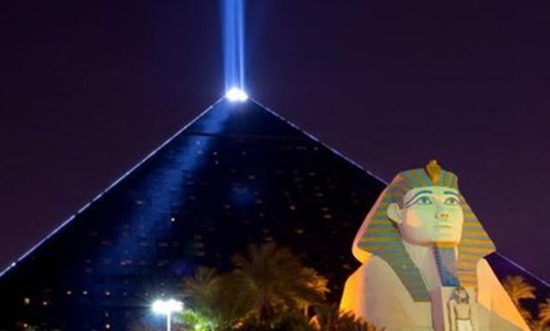
Watch a Brilliant Column of Light Rise Above the Las Vegas Strip
The Luxor Sky Beam shines upward from the top of the black-glass Luxor pyramid, creating one of the most recognizable nighttime sights on the Las Vegas Strip. The narrow white column can be seen from locations across the Las Vegas Valley when weather and visibility are favorable.
Viewing the beam from legally accessible public areas is free, making it an easy nighttime addition to the many free things to do in Las Vegas. No attraction ticket, hotel reservation, casino play, or purchase is required merely to see it.
The beam is an illuminated landmark rather than a scheduled light show. It does not change colors, move across the sky, or present a choreographed performance. Visitors simply look toward Luxor after dark and watch the concentrated light extend above the pyramid.
Luxor does not publish guaranteed Sky Beam operating hours. Maintenance, weather, visibility, energy use, and technical conditions can affect how bright or clearly defined it appears.
Last reviewed: July 20, 2026. Beam operation, brightness, parking, pedestrian access, exterior lighting, and nighttime visibility can change.
Luxor Sky Beam Quick Facts
- Cost: Free to view from legally accessible public areas.
- Location: Projected from the top of the Luxor pyramid.
- Address: 3900 S. Las Vegas Blvd., Las Vegas, NV 89119
- Luxor Phone: (702) 262-4000
- Best Viewing Time: After full darkness.
- Published Schedule: Luxor does not currently publish guaranteed operating hours.
- Debut: October 1993, when Luxor opened.
- Light Source: A group of powerful xenon lamps and curved reflectors.
- Full-System Design: Historically rated at approximately 42.3 billion candelas.
- Current Brightness: Not publicly specified and not guaranteed to reach the original maximum output.
- Experience Type: Exterior nighttime landmark rather than a scheduled performance.
- Time Needed: Approximately 10 to 20 minutes for viewing and photographs.
- Best For: Night photographers, architecture fans, aviation enthusiasts, first-time visitors, and south-Strip explorers.
- Public Lamp-Room Access: None. The technical area near the pyramid’s apex is restricted.
- Parking: Luxor has paid self-parking and valet parking. Review the Las Vegas parking fees guide before visiting.
- What May Cost Extra: Parking, transportation, food, drinks, hotel rooms, shows, and other resort activities.
What to Expect When Viewing the Sky Beam
The Sky Beam appears as a bright white column rising vertically from the pyramid. Its appearance can change noticeably from one night to another.
On a clear, dry night, the beam may appear narrow and sharply defined near the pyramid but less visible farther into the sky. Light haze, dust, or moisture can make more of the column visible because particles scatter the light toward observers.
Clouds can create especially dramatic effects. A low cloud layer may reflect the light and create a glowing patch above Luxor, while heavier weather can partially hide the beam.
The experience does not have a formal entrance, viewing platform, queue, narration, music, or assigned showtime. Most visitors see it while walking near Luxor, driving through the valley, looking from another resort, or arriving by airplane after dark.
The beam remains part of Luxor’s exterior, but visitors should not make a long trip expecting a guaranteed level of brightness. Individual lamps may be inactive, and technical or weather conditions can reduce visibility.
How the Luxor Sky Beam Works
The beam does not come from one enormous bulb at the visible point of the pyramid. Multiple xenon lamps operate in a restricted technical area below the apex.
Curved reflectors collect and concentrate the lamps’ light into one vertical column that exits near the top of the pyramid.
The original system used 45 lamps. A later, more efficient configuration used 39 high-powered lamps and improved reflectors. Luxor has also reportedly operated the beam below its maximum designed output to reduce energy use and operating costs.
The equipment requires specialized maintenance and is not open to the public. There is no observation deck, visitor window, elevator ride, backstage tour, or ticket that provides access to the lamp room.
How Far Away Can the Luxor Beam Be Seen?
The beam can be seen from many parts of the Las Vegas Valley, but there is no single guaranteed viewing distance.
Its visibility depends on:
- Weather and atmospheric clarity
- Dust, smoke, humidity, and clouds
- The observer’s elevation
- The number of lamps operating
- Competing city lights
- The viewing angle
Historical promotional claims said airplane passengers could see the beam from approximately 250 miles away under ideal conditions. That claim referred to aircraft at cruising altitude rather than people viewing it from ground level.
Luxor personnel later offered a more conservative estimate of approximately 100 miles for pilots. Normal ground-level visibility is considerably more limited.
Can the Luxor Beam Be Seen From Space?
Not as the distinct, sharply defined column often described in Las Vegas legends.
The broader glow of Las Vegas can be photographed from orbit, but the narrow Luxor beam scatters through the lower atmosphere and does not remain a clearly separated column extending into space.
Why Are Things Flying Inside the Beam?
The intense light attracts moths and other flying insects. Bats may gather to feed on the insects, and birds can also hunt around the same concentrated food source.
From the ground, these animals may look like bright, fast-moving objects circling within the beam. Videos sometimes describe them as UFOs, but insects, bats, and birds provide the usual explanation.
Wildlife activity varies according to the season, temperature, wind, rainfall, insect populations, migration patterns, and the beam’s operating strength.
No gathering is guaranteed. Visitors may see many moving shapes on one night and almost none on another.
Do not use lasers, drones, powerful spotlights, thrown objects, loud sounds, or other devices to attract or interfere with the animals.
Where to See the Luxor Sky Beam
Outside Luxor
The closest ordinary views are available from legally accessible exterior areas around Luxor. These positions can include the pyramid, Sphinx, obelisk, and beam in the same photograph.
Remain on public walkways and stay outside roadways, landscaping, pool areas, loading zones, and restricted resort spaces.
South Strip Sidewalks
The beam can be seen from many pedestrian areas near Luxor, Excalibur, Mandalay Bay, and surrounding south-Strip properties.
Use established sidewalks, bridges, escalators, elevators, and crossings. Never step into Las Vegas Boulevard or a resort driveway for a photograph.
Elevated Public Walkways
Pedestrian bridges and publicly accessible elevated areas can provide a clearer view above vehicles, signs, and landscaping. Access and hours depend on the individual property.
Elsewhere in the Las Vegas Valley
The beam can sometimes be seen from neighborhoods, parking areas, hills, roadways, and scenic viewpoints miles from the Strip.
Use only places where stopping, parking, and nighttime access are legal. Do not enter private property, climb utility structures, block roads, or stop on freeway shoulders.
From an Airplane
Passengers arriving or departing after dark may see the beam when the aircraft route, altitude, weather, window position, and cabin lighting are favorable. It should not be treated as a guaranteed feature of a flight.
Tips for Photographing the Luxor Sky Beam
- Wait until full darkness: The beam is easier to separate from the sky after twilight fades.
- Include the pyramid: Showing the apex makes the source and scale of the beam immediately clear.
- Use a vertical composition: Portrait orientation gives the beam more room to extend upward.
- Try a wide-angle view: Include the Sphinx, pyramid, nearby resorts, and surrounding Strip lights.
- Reduce exposure: Automatic settings may overexpose the bright apex.
- Keep the camera steady: Rest the phone or camera against a stable public railing when a tripod is impractical.
- Use night mode carefully: Long exposures may improve the beam but blur people, vehicles, bats, and clouds.
- Try video: Video can capture clouds, insects, bats, and changing atmospheric effects.
- Do not use a drone: Airspace around the Strip and Harry Reid International Airport is heavily restricted.
- Do not stop in traffic: Photograph only from legal pedestrian or parking areas.
- Keep walkways open: Do not block bridges, escalators, entrances, sidewalks, or emergency routes.
- Ask before professional photography: Tripods, lights, models, and commercial filming may require property permission.
How to Visit Luxor and See the Beam
Luxor is at the southern end of the Strip between Excalibur and Mandalay Bay.
Address: 3900 S. Las Vegas Blvd., Las Vegas, NV 89119
Driving
Follow current signs for Luxor self-parking, valet parking, hotel registration, and passenger drop-off. Do not stop along Las Vegas Boulevard, Mandalay Bay Road, resort driveways, fire lanes, or rideshare areas merely to photograph the beam.
Rideshare and Taxi
Luxor uses designated pickup and drop-off areas away from the main Strip sidewalk. Confirm the exact location shown in the app.
Review the Las Vegas Ride Share Guide or the Las Vegas taxi guide before traveling.
Public Transportation
RTC buses serve the Las Vegas Boulevard corridor. Routes, stops, fares, construction detours, and schedules can change.
Review the trip through the Las Vegas public transportation guide.
Walking from Nearby Resorts
Luxor connects with Excalibur and Mandalay Bay through resort walkways and transportation routes. Tram, moving-walkway, escalator, elevator, and passage availability can change.
Follow current resort signs and allow additional time if an expected route is unavailable.
A Brief History of the Luxor Sky Beam
Luxor opened in October 1993 as a heavily themed resort built around a 30-story black-glass pyramid. The Sky Beam debuted as the building’s defining nighttime feature.
Its intense light and unusual pyramid setting quickly made it part of Las Vegas folklore. Over the years, stories claimed that the beam could be seen from space, that one giant bulb powered it, and that unexplained flying objects gathered inside it.
The actual explanation is less mysterious but still impressive: a group of powerful xenon lamps and reflectors projects concentrated light into the atmosphere, where dust, moisture, insects, bats, and clouds help make the beam visible.
Luxor Sky Beam FAQ
Q: Is the Luxor Sky Beam free to see?
A: Yes. No ticket or hotel reservation is required to view it from legally accessible public areas. Parking, transportation, food, shows, and other activities may cost extra.
Q: Is the Sky Beam still operating?
A: Yes. It remains part of Luxor’s nighttime exterior, although maintenance, weather, technical conditions, and operating decisions can affect its brightness.
Q: What time does it turn on?
A: Luxor does not currently publish guaranteed operating hours. The system has historically operated from around dusk until before dawn.
Q: Is it a scheduled light show?
A: No. It is a nighttime landmark rather than a choreographed show with music or changing colors.
Q: Is it the brightest light in the world?
A: The full system was widely promoted as the world’s brightest man-made beam and historically rated at approximately 42.3 billion candelas. Its current nightly output is not publicly specified.
Q: Does it use 315,000 watts?
A: The original 45-lamp arrangement totaled approximately 315,000 watts. A later, more efficient system used 39 lamps, and the beam has reportedly operated below full strength.
Q: Is it one giant light bulb?
A: No. Multiple xenon lamps and curved reflectors combine their light into one concentrated beam.
Q: Can it be seen from 250 miles away?
A: That was a historical estimate for aircraft at cruising altitude under ideal conditions, not ordinary ground-level viewing.
Q: Can it be seen from space?
A: Not as the clearly defined column often described in popular myths. Las Vegas produces a broad glow visible from orbit, but the beam disperses through the atmosphere.
Q: Is the beam a laser?
A: No. It is produced by xenon lamps and reflectors rather than a laser.
Q: Can visitors tour the lamp room?
A: No. The lamp room and upper pyramid access routes are restricted technical areas.
Q: What are the moving objects inside the beam?
A: They are commonly moths, other insects, bats, or birds illuminated as they pass through the light.
Q: Does the beam attract bats?
A: Yes. Insects attracted by the light can create a feeding opportunity for bats. Activity varies by season and weather.
Q: Was the beam created because ancient Egyptians believed souls traveled to heaven through light?
A: The beam complements Luxor’s Egyptian-inspired architecture, but that specific explanation is not supported by a reliable account of the project’s design.
Q: Is parking free at Luxor?
A: No. Luxor has paid self-parking and valet parking. Rates and MGM Rewards benefits can change.
Q: Is the Luxor Sky Beam worth a special trip?
A: It is worthwhile for night photographers, architecture fans, and first-time visitors. Most people should combine it with another Luxor or south-Strip activity.