Moulin Rouge Historic Site
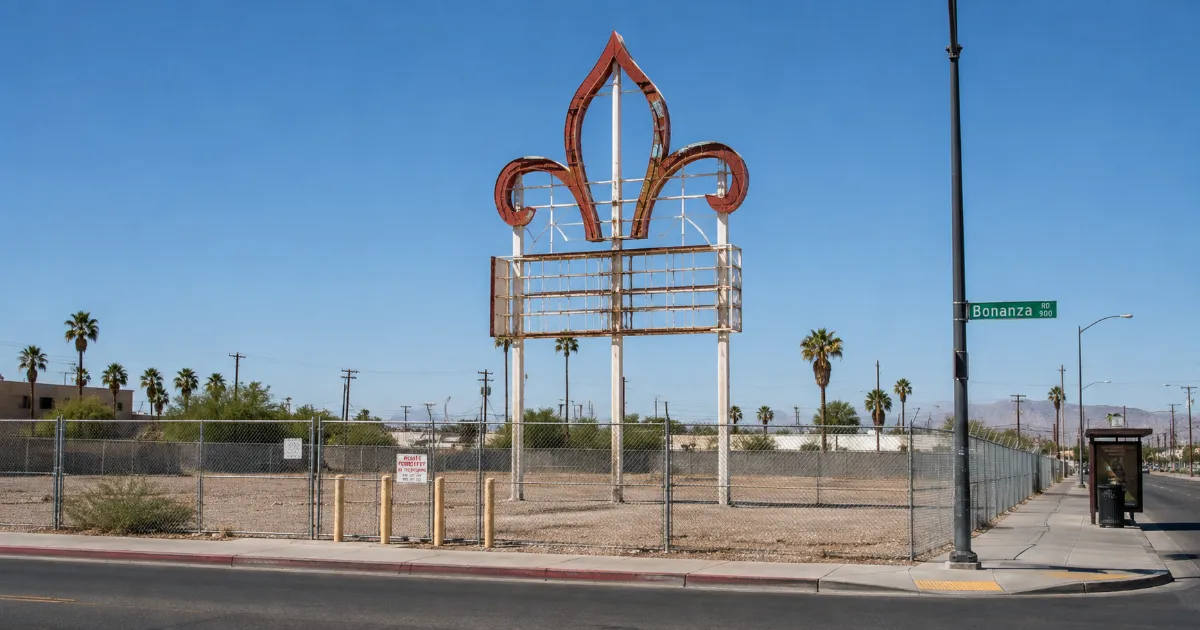
Moulin Rouge Historic Site in Las Vegas
The Moulin Rouge Historic Site at 900 W. Bonanza Road marks the former home of one of the most consequential hotel-casinos in Las Vegas history. The Moulin Rouge opened on May 24, 1955, as a racially integrated resort that welcomed Black and white guests, performers, and employees during an era when segregation remained common elsewhere in the city.
The original hotel-casino no longer stands. Fires, deterioration, and safety-related demolition removed the surviving buildings and major architectural features. The property is now primarily a secured vacant site and is not an operating casino, hotel, museum, park, or public attraction.
The historic property is not open to the public. Visitors should view it only from legal public areas and must not enter the parcel, cross fencing, use the site for parking, or attempt an unofficial tour.
Last reviewed: August 3, 2026. Property access, fencing, ownership, preservation activity, and redevelopment proposals can change.
Opening and Integration | Civil Rights Legacy | Closure and Fires | The Site Today | Preserved Neon Sign | Historic Recognition | Viewing the Site | FAQ
A Groundbreaking Integrated Hotel-Casino
The Moulin Rouge opened in the Historic Westside on May 24, 1955. Its hotel, casino, dining, entertainment, and employment practices were integrated at a time when Black entertainers could perform at major Las Vegas resorts but were often denied equal access to their hotels, restaurants, casinos, and public areas.
The Moulin Rouge welcomed guests and employees across racial lines. Black workers held visible and better-paying positions that were often unavailable to them at other Las Vegas properties, including jobs as dealers, cocktail servers, bartenders, security employees, and managers.
Boxing champion Joe Louis served as a public host. The resort became known for integrated audiences, elaborate entertainment, and late-night performances that attracted entertainers, casino employees, local residents, and visitors after other Las Vegas shows ended.
Although the resort created a national sensation, its original operation lasted less than six months. It closed in October 1955 amid financial and management problems.
The Moulin Rouge Agreement and Las Vegas Civil Rights
The closed property remained important to the local civil rights movement. On March 26, 1960, Black community leaders, NAACP representatives, government officials, and hotel executives met at the Moulin Rouge while activists prepared a protest against segregation in Las Vegas public accommodations.
The discussions produced what became known as the Moulin Rouge Agreement. Major Las Vegas properties agreed to end many segregation practices affecting public access to dining, gaming, and entertainment.
The agreement was an important local civil rights milestone, although it did not immediately eliminate every form of employment discrimination or racial inequality in the hospitality industry.
Later Operations, Fires, and Demolition
Different owners and operators attempted to reopen or redevelop the Moulin Rouge after its original closure. None restored the property to the prominence it held during 1955.
A major fire severely damaged the complex in 2003. Another fire occurred in 2009, and the deteriorated front facade and iconic tower were demolished in 2010 after safety concerns.
Additional fires in 2017 destroyed the remaining buildings. The damaged structural remains were subsequently removed, leaving a largely vacant parcel.
Historic photographs showing the original hotel, casino, tower, showroom, and neon signage should not be mistaken for current visitor conditions.
What Remains at the Site Today
The Bonanza Road property no longer contains an operating Moulin Rouge resort or a preserved public museum complex. The site is largely vacant, with limited physical evidence of its former use.
A remaining roadside marquee or fleur-de-lis framework has served as one of the few visible reminders of the former property. Its condition and continued presence can change because the parcel is not maintained as a public historic attraction.
The Historic Westside planning process has identified the broader Moulin Rouge area as a potential location for future mixed-use, entertainment, housing, workforce, educational, and commemorative development. Planning aspirations should not be described as approved construction or a confirmed reopening.
The Moulin Rouge Sign at The Neon Museum
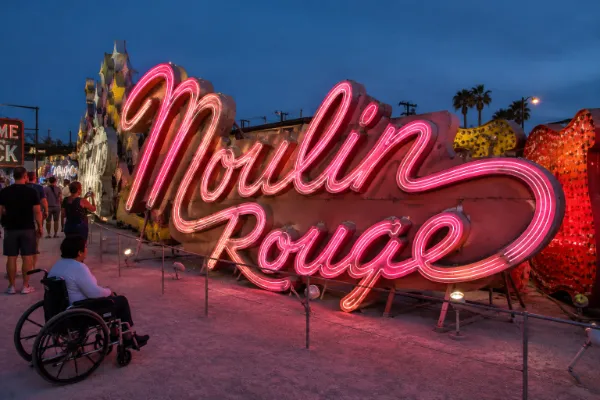
The famous cursive Moulin Rouge sign was designed by Betty Willis, who later created the “Welcome to Fabulous Las Vegas” sign. She researched French-style lettering and drew the Moulin Rouge script by hand.
The original sign was removed from the Bonanza Road property shortly before the 2009 fire and transferred to The Neon Museum for preservation. It was restored and relit in 2020.
Visitors who want to see the preserved sign should consult The Neon Museum’s current admission and tour information. The sign is not displayed at the former hotel-casino site.
National Register of Historic Places
The Moulin Rouge Hotel was added to the National Register of Historic Places in 1992 because of its association with African American history, integration, and the civil rights movement.
National Register recognition documents the property’s historical importance. It does not mean that the vacant parcel is a staffed federal park, operating museum, or public-access facility.
The destruction of the principal buildings also means that visitors should focus on the site’s documented history rather than expect an intact 1950s resort.
Viewing the Historic Site Safely
The National Park Service identifies the Moulin Rouge property as not open to the public. There are no verified regular tours, admission hours, visitor facilities, restrooms, exhibits, parking services, or staffed interpretation at the site.
Anyone passing the property should remain on legal public sidewalks or other authorized public areas. Do not cross fences, enter vacant land, touch structures, park on the parcel, or attempt to retrieve objects.
Traffic along Bonanza Road and changing site conditions may make casual roadside viewing difficult. Visitors should not stop in a travel lane or create an unsafe photography position.
For structured historical interpretation, consider visiting The Neon Museum to see the preserved sign or using official City of Las Vegas, Clark County, and National Park Service resources about the Historic Westside and Moulin Rouge Agreement.
Frequently Asked Questions
Q: Where was the Moulin Rouge Hotel and Casino?
A: The historic property was at 900 W. Bonanza Road in the Historic Westside of Las Vegas.
Q: Is the Moulin Rouge still open?
A: No. The hotel-casino closed during its original 1955 operation, and later reopening efforts did not restore it as a permanent resort.
Q: Are the original buildings still standing?
A: No. Fires, deterioration, and safety-related demolition removed the hotel, casino, facade, tower, and remaining structures.
Q: Can visitors enter the historic site?
A: No. The National Park Service identifies the property as not open to the public. Visitors must remain outside the secured parcel.
Q: Why is the Moulin Rouge historically important?
A: It opened as a groundbreaking integrated hotel-casino and later hosted the 1960 negotiations that helped desegregate Las Vegas public accommodations.
Q: Where is the original Moulin Rouge neon sign?
A: The preserved cursive sign is held and displayed by The Neon Museum rather than at the Bonanza Road site.
Q: Is the property on the National Register of Historic Places?
A: Yes. The Moulin Rouge Hotel was listed in the National Register in 1992.
Q: Is a new Moulin Rouge being built?
A: Various redevelopment concepts have been discussed over the years, but no unverified proposal should be treated as a confirmed reopening or active construction project.