Walk Through Five Hoover Dam-Era Tunnels Above Lake Mead
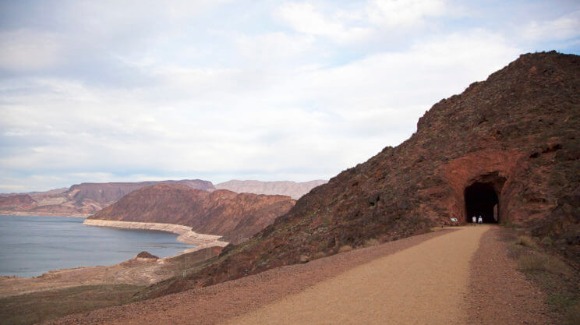
The Historic Railroad Trail at Lake Mead National Recreation Area follows a former railroad grade built to transport equipment and construction materials for Hoover Dam. The broad gravel trail passes through five tunnels while providing elevated views of Lake Mead, Boulder Basin, desert mountains, and historic construction sites.
The trail appears in our guide to free things to do near Las Vegas because there is no separate trail ticket or parking charge. However, it is inside the Lake Mead National Recreation Area fee zone, so visitors must have a valid park entrance pass.
The National Park Service rates the maintained trail as easy because it follows a mostly level railroad bed. Its 7.5-mile round-trip distance, exposed desert setting, limited shade, and extreme summer heat can still make the complete route physically demanding.
Visitors may hike, bicycle, use a wheelchair or mobility device, push a stroller, or walk a leashed dog. You do not have to complete the entire route; shorter out-and-back walks can still provide lake views, interpretive signs, and access to some of the historic tunnels.
Last reviewed: July 20, 2026. The trail is currently open and remains available during Lake Mead’s annual summer closures of certain more strenuous trails. Entrance fees, weather hazards, tunnel conditions, parking, water availability, and temporary access restrictions can change.
Historic Railroad Trail Quick Facts
- Trail Use: No separate trail ticket is required.
- Park Entry: A Lake Mead National Recreation Area entrance pass is required.
- Current Private-Vehicle Fee: $25 for a pass valid for one to seven days.
- Current Motorcycle Fee: $20.
- Current Walking or Bicycling Fee: $15 per visitor age 16 or older.
- Passes Accepted: Lake Mead annual passes and valid America the Beautiful interagency passes.
- Payment: Lake Mead entrance stations use cashless payment.
- Trailhead: Below the Lake Mead Visitor Center on Lakeshore Road.
- Visitor Center Address: 10 Lakeshore Road, Boulder City, NV 89005.
- Trail Distance: 3.7 miles one way and approximately 7.5 miles round trip.
- Difficulty: Easy according to the National Park Service, although heat and distance can substantially increase difficulty.
- Surface: Firm, hard-packed fine gravel.
- Width: Approximately 10 feet through much of the accessible route.
- Elevation: The National Park Service lists approximately 11 feet of elevation change.
- Tunnels: Five historic railroad tunnels.
- Reservations: Not required for an ordinary trail visit.
- Typical Time: Approximately one to four hours, depending on the distance traveled and number of stops.
- Trailhead Facilities: Accessible pit toilets, trash receptacles, and a self-service bicycle repair station.
- Drinking Water: Available at the nearby Lake Mead Visitor Center during its operating hours, but not guaranteed along the trail.
- Visitor Center Hours: Daily from 9:00 a.m. to 4:30 p.m., with holiday closures.
- Pets: Permitted on leashes no longer than six feet.
- Bicycles: Permitted.
- Best Season: Fall through spring.
- Summer: The trail remains open, but the National Park Service does not recommend hiking it during extreme heat.
- Park Information: (702) 293-8990
What to Expect on the Historic Railroad Trail
The trail follows a wide former railroad bed carved into the mountains above Boulder Basin. It is considerably broader and flatter than a typical desert hiking path because trains once transported heavy machinery and construction materials along the route.
Lake Mead views appear along much of the exposed first portion of the trail. The appearance of the reservoir, shoreline, islands, coves, and distant mountains varies with water levels, weather, haze, and seasonal light.
The route includes interpretive panels explaining the railroad, Hoover Dam construction, geology, wildlife, and surviving industrial remnants.
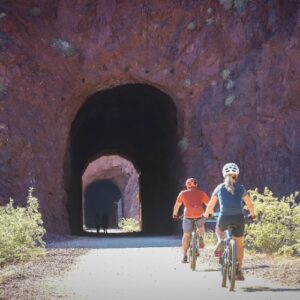
There is little natural shade before the tunnels. Once inside a tunnel, temperatures may feel cooler, but visitors should not rely on the tunnels as dependable protection from prolonged heat.
The route is shared by walkers, runners, bicyclists, mobility-device users, families, and leashed pets. Stay to one side, remain aware of faster users approaching from behind, and avoid stopping in the center of the trail.
This is an outdoor historical trail rather than a staffed attraction. There are no shops, restaurants, guided presentations, guaranteed ranger programs, or drinking-water stations along the full route.
How Far Do You Need to Walk?
Short Scenic Walk
Visitors can walk a portion of the exposed railroad grade for lake views and then return to the trailhead. This works well for limited schedules, families, and visitors who do not need to reach the tunnels.
Walk to the Tunnels
Continue along the rail bed to reach the five tunnels carved through the mountains. The tunnels are the trail’s primary historical feature.
Complete One-Way Route
The full trail continues approximately 3.7 miles from the Lake Mead trailhead toward Hoover Dam.
Complete Round Trip
Returning to the original trailhead produces an approximately 7.5-mile outing.
Turn Around When Necessary
Do not let the easy rating create pressure to finish the entire trail. Turn around before half of the available water, energy, daylight, or comfortable temperature has been used.
Hoover Dam Connection
The trail connection to Hoover Dam opened to the public in 2007. Visitors continuing into the Hoover Dam area must follow current Bureau of Reclamation access, security, pedestrian, and operating rules.
There is no current public shuttle advertised to return hikers from Hoover Dam to the Lake Mead trailhead. Anyone completing a one-way hike should arrange legal transportation in advance rather than assuming a ride will be available.
Walking Through the Five Railroad Tunnels
The trail passes through five tunnels originally created for the Hoover Dam construction railroad.
Each tunnel is approximately 25 feet wide, 30 feet high, and 300 feet long. Their large dimensions allowed trains to carry oversized equipment and construction materials.
Tunnel Surfaces
The hard-packed trail continues through the tunnels. Two include protective shipping-container structures with short ramps at each end to protect visitors from occasional small falling rocks.
Changing Light
The interiors are considerably darker than the sunlit approach. Allow your eyes time to adjust, remove sunglasses, and keep children close.
Rock Protection
Do not climb tunnel walls, touch overhead reinforcement, enter gaps beside protective structures, or remove rocks and historical materials.
Bicycle Safety
Cyclists should slow down before entering a tunnel, use appropriate lighting when needed, watch for pedestrians, and avoid passing where visibility is limited.
Echoes and Noise
Voices, bicycle sounds, and other noises echo strongly. Avoid shouting, amplified music, and behavior that prevents others from hearing approaching trail users.
Tunnels 2 and 5 experienced historical fire damage. Stabilization materials and protective features visible today are part of the trail’s continuing safety and preservation work.
How the Railroad Helped Build Hoover Dam
In 1931, the federal government and Six Companies, Inc. began constructing nearly 30 miles of railroad connecting Boulder City and the Hoover Dam site with cement plants, gravel facilities, quarries, and other construction resources.
Trains operated around the clock during major construction periods, carrying workers, machinery, aggregate, cement, pipe, and equipment too large or heavy for ordinary roads.
The railroad grade’s gentle slope and broad curves explain why today’s trail is relatively level and accessible.
After Hoover Dam was completed, portions of the system continued to be used intermittently. The tracks were dismantled in 1962.
The recreational trail was established in 1992, and the public connection extending toward Hoover Dam opened in 2007.
Historical features along the route include:
- The five railroad tunnels.
- Interpretive exhibits about dam construction.
- Original cuts through the volcanic rock.
- Concrete plugs removed during turbine installation.
- Railroad and construction remnants near the Hoover Dam end of the route.
All historical objects are protected. Do not remove railroad materials, rocks, metal, wood, construction debris, plants, or other objects from the recreation area.
Entrance Fees, Passes, and Trailhead Parking
The trail itself has no separate admission charge, but the National Park Service identifies it as being inside the Lake Mead National Recreation Area fee zone.
Private Vehicle
The current standard entrance fee is $25 and covers the occupants of one private, noncommercial vehicle for one to seven days.
Motorcycle
The current motorcycle entrance fee is $20.
Walking or Bicycling
Visitors age 16 and older entering without a motor vehicle currently pay $15 per person. Children age 15 and younger enter without charge.
Annual and Interagency Passes
A valid Lake Mead annual pass or America the Beautiful pass may cover entry under the terms of that pass.
Cashless Payments
Lake Mead entrance stations accept electronic payments and no longer accept cash for entrance fees.
Trailhead Parking
The trail parking lot is below the Lake Mead Visitor Center on Lakeshore Road. There is no separate trailhead parking charge after satisfying the park-entry requirement.
Keep Proof of Admission in the Vehicle
Display or retain the entrance pass as instructed so park staff can verify admission.
Passes Are Not Sold Inside the Visitor Center
Purchase a pass online or through an operating entrance station. Do not depend on the Visitor Center to sell one after arrival.
Wheelchair, Mobility Device, and Stroller Access
The National Park Service describes the Historic Railroad Trail as universally accessible.
Trail Width
The accessible surface is approximately 10 feet wide through much of the route.
Surface
The trail consists of firm, stabilized fine gravel suitable for many wheelchairs, mobility devices, and strollers.
Grade
The typical grade is approximately 0.9%, with a published maximum grade of about 5%.
Tunnel Ramps
Protective shipping-container sections in two tunnels have short ramps at their entrances and exits.
Trailhead Restrooms
Accessible pit toilets are available near the trailhead.
Outdoor Variables
Heat, loose gravel, wind, debris, maintenance, individual equipment, battery range, tire type, and the length of the return trip may affect accessibility during a particular visit.
Visitors with specific mobility needs should call the Lake Mead Visitor Center before traveling and ask about current surface and tunnel conditions.
Bicycles and Leashed Pets Are Permitted
Bicycling the Trail
The Historic Railroad Trail is a designated multi-use route open to bicycles.
Cyclists should control their speed, announce passes, yield when necessary, and expect walkers, children, pets, strollers, and mobility devices inside the tunnels.
A self-service bicycle repair station is available near the trailhead, but riders should carry a repair kit, spare tube or patching supplies, pump, water, and other essentials.
Electric bicycle use must comply with current National Park Service rules, posted restrictions, and the applicable e-bike classification requirements.
Visiting with a Dog
Pets are allowed but must remain on a leash no longer than six feet. Owners must remove waste and keep animals under physical control.
Bring separate drinking water for each pet. Do not allow an animal to drink from puddles, utility water, runoff, or other untreated sources.
Hot trail surfaces can burn paws. The National Park Service warns that when the air temperature is approximately 85°F, the trail surface may reach about 135°F. At an air temperature of 110°F, the trail surface can exceed 160°F.
Never leave an animal unattended in a vehicle, tied at the trailhead, or alone along the route.
Heat and Desert Safety
Avoid Summer When Possible
The National Park Service does not recommend this trail during summer because temperatures commonly reach 100°F–115°F and there is no shade for approximately the first 1.5 miles.
Open Does Not Mean Safe
The trail remains open during Lake Mead’s annual May 15–September 30 closures of certain more strenuous routes. That does not mean midday summer conditions are safe.
Start Early
During warm weather, begin near sunrise and establish a firm turnaround time before temperatures rise.
Carry All Necessary Water
Do not rely on the Visitor Center being open, water being available, or another visitor being able to help.
Watch for Heat Illness
Turn back immediately if anyone experiences headache, dizziness, weakness, nausea, confusion, heavy sweating followed by reduced sweating, or unusual fatigue.
Wear Sun Protection
Use sunscreen, a hat, sunglasses, lightweight protective clothing, and sturdy closed-toe shoes.
Check the Forecast
Avoid the trail during extreme heat warnings, thunderstorms, lightning, high winds, heavy rain, or other dangerous weather.
Tell Someone Your Plan
Share the trail, vehicle information, expected route, and return time with someone not participating in the outing.
Carry a Charged Phone
Cellular service can be inconsistent. A phone should supplement rather than replace water, navigation, and advance planning.
Emergency:
Call 911. Provide the trail name, tunnel number or nearest interpretive feature, direction of travel, and the nature of the emergency.
How to Reach the Historic Railroad Trail
The trailhead parking lot is on Lakeshore Road below the Lake Mead Visitor Center. The Visitor Center address is 10 Lakeshore Road, Boulder City, NV 89005.
Use Current Navigation
Search for “Lake Mead Visitor Center” or “Historic Railroad Trailhead” rather than relying on the old U.S. 93 and Buchanan Boulevard directions.
From Las Vegas
Travel toward Boulder City using the current I-11, U.S. 93, and U.S. 95 highway network. Follow current signs toward Lake Mead National Recreation Area and Lakeshore Road.
Park Below the Visitor Center
The Historic Railroad Trail lot is separate from the primary Visitor Center parking area. Follow trailhead signs rather than assuming the nearest building entrance is the trail start.
Entrance Pass
The trail is in a fee area. Purchase the required entrance pass online or at an operating entrance station and retain proof with the vehicle.
Public Transportation
The National Park Service states that there is no ordinary public transportation into Lake Mead National Recreation Area.
Rideshare
A rideshare driver may provide a drop-off, but return availability and cellular service are not guaranteed. Arrange the return before beginning the trail and review the Las Vegas Ride Share Guide.
Bicycle Access
Experienced cyclists can reach the recreation area using regional shared-use routes such as the River Mountains Loop Trail. Park entrance fees still apply to people entering by bicycle.
Video Preview of the Historic Railroad Trail
This video provides an example of the trail, tunnels, Lake Mead views, and surrounding desert. Water levels, trail surfaces, protective structures, vegetation, weather, and access conditions may have changed since filming.
Historic Railroad Trail FAQ
Q: Is the Historic Railroad Trail free?
A: There is no separate trail or parking fee, but the trailhead is inside the Lake Mead National Recreation Area fee zone. A valid park entrance pass is required.
Q: How much is the current Lake Mead entrance fee?
A: Current standard fees are $25 per private vehicle, $20 per motorcycle, or $15 per person age 16 or older entering on foot or bicycle.
Q: Are national park passes accepted?
A: Yes. Valid America the Beautiful interagency passes and Lake Mead annual passes are accepted according to their current terms.
Q: Can visitors pay the entrance fee with cash?
A: No. Lake Mead uses cashless fee collection for entrance passes.
Q: How long is the trail?
A: It is approximately 3.7 miles one way and 7.5 miles round trip when returning to the same trailhead.
Q: Must visitors complete the entire trail?
A: No. It is an out-and-back route, so visitors can turn around after a shorter lake-view walk or after reaching some of the tunnels.
Q: How many tunnels are there?
A: The route passes through five historic railroad tunnels.
Q: How large are the tunnels?
A: Each is approximately 25 feet wide, 30 feet high, and 300 feet long.
Q: Is the trail difficult?
A: The National Park Service rates it easy because the former railroad grade is broad and mostly level. The full distance and desert heat can make it strenuous for some visitors.
Q: Is the trail wheelchair accessible?
A: Yes. It has a firm, approximately 10-foot-wide gravel surface with a low typical grade. Current outdoor conditions and individual mobility equipment can still affect access.
Q: Are strollers permitted?
A: Yes. The trail is described as stroller friendly, although a stroller with larger outdoor wheels may handle the gravel more comfortably.
Q: Are bicycles allowed?
A: Yes. Cyclists must share the route safely with pedestrians, pets, children, and mobility-device users.
Q: Are dogs allowed?
A: Yes. Dogs must remain on a leash no longer than six feet, and owners must remove waste and protect paws from dangerously hot surfaces.
Q: Are restrooms available?
A: Accessible pit toilets are available at the trailhead. Restrooms are not distributed throughout the full route.
Q: Is drinking water available?
A: Water may be available at the nearby Lake Mead Visitor Center during operating hours. Visitors should carry all water needed for the complete outing.
Q: Is the trail open during summer?
A: It currently remains open, but the National Park Service does not recommend summer hiking because of extreme temperatures and limited shade.
Q: Does the trail reach Hoover Dam?
A: The full route connects toward the Hoover Dam visitor area. Hoover Dam has separate access, security, parking, and operating rules.
Q: Is a shuttle available back to the trailhead?
A: No current public return shuttle is advertised. Visitors should plan an out-and-back trip or arrange legal transportation in advance.
Q: Where is the trailhead?
A: The trailhead parking lot is below the Lake Mead Visitor Center on Lakeshore Road near Boulder City.